Available for senior roles · Berlin / EU-remotelat: 52.52°Ntz: Europe/Berlin
Amir Golparvar.
Senior full-stack & AI engineer building production data platforms, distributed
ingestion pipelines, and RAG systems for scientific research.
Currently at FAIRmat / Humboldt-Universität zu Berlin, shipping the platform that
materials scientists across 10+ institutions rely on.
Platforms researchers use every day to manage, share, and reason about scientific data —
end-to-end ownership from database schema and ingestion pipeline to React UI and Kubernetes deployment.
NOMAD
in production
2020 — present
FAIRmat·Humboldt-Universität zu Berlin·full-stack
I joined NOMAD in 2020 as a backend developer and grew into full-stack ownership over four years. NOMAD is a federated platform for materials science research data: it ingests, validates, processes, and makes searchable over 19 million entries and 114 TB+ of scientific data across 10+ partner institutions, serving a community of 600+ researchers.
On the backend, I design and operate FastAPI microservices for ingestion and processing, orchestrate distributed task queues with Celery and Temporal, and manage the Elasticsearch indices that drive faceted search across heterogeneous metadata from 60+ scientific file formats. On the frontend, I lead the NOMAD GUI — React + Vite + Material UI + TanStack Query + Plotly — for uploads, search, interactive data viewers, and admin tooling.
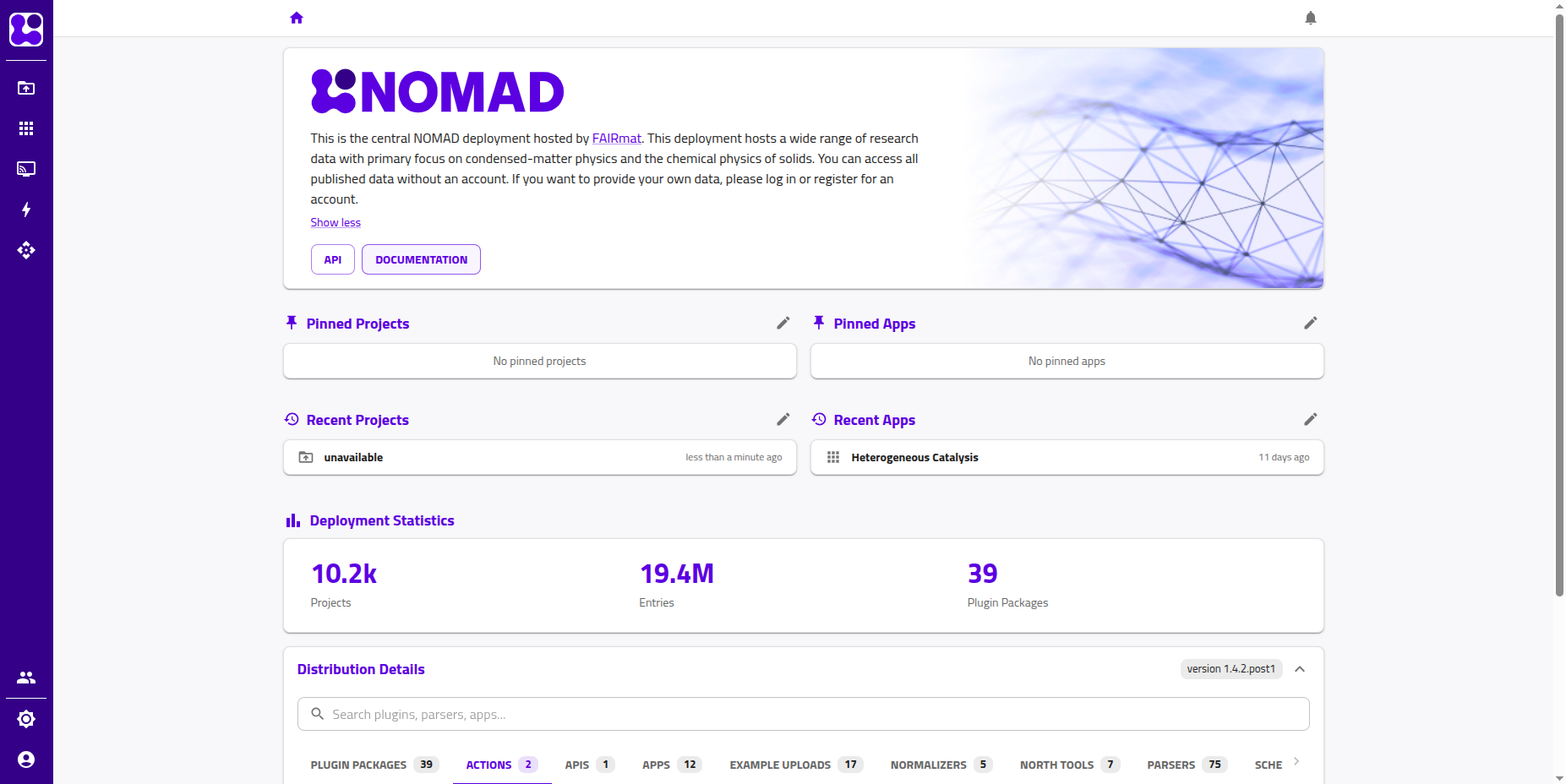
NOMAD frontend — faceted search across millions of entries, interactive visualizations, and a unified archive viewer for results from 40+ simulation tools.
The platform runs in two deployment modes: single-node Docker Compose for partner institutes who run their own instance, and full Kubernetes (Helm) on Max Planck's HPC infrastructure at MPCDF Garching for the central production deployment. I own the deployment story for both, including orchestration of Elasticsearch, MongoDB, RabbitMQ, Keycloak, and nginx behind a reverse proxy.
I also develop NOMAD plugins — parsers and schema packages that extend the platform to new scientific domains — and co-developed the Electronic Lab Notebook (ELN) module that lets researchers capture and share experimental workflows. The full codebase ships under TDD/BDD practice: end-to-end Playwright suites, integration tests with pytest, module docs in MkDocs and Storybook.
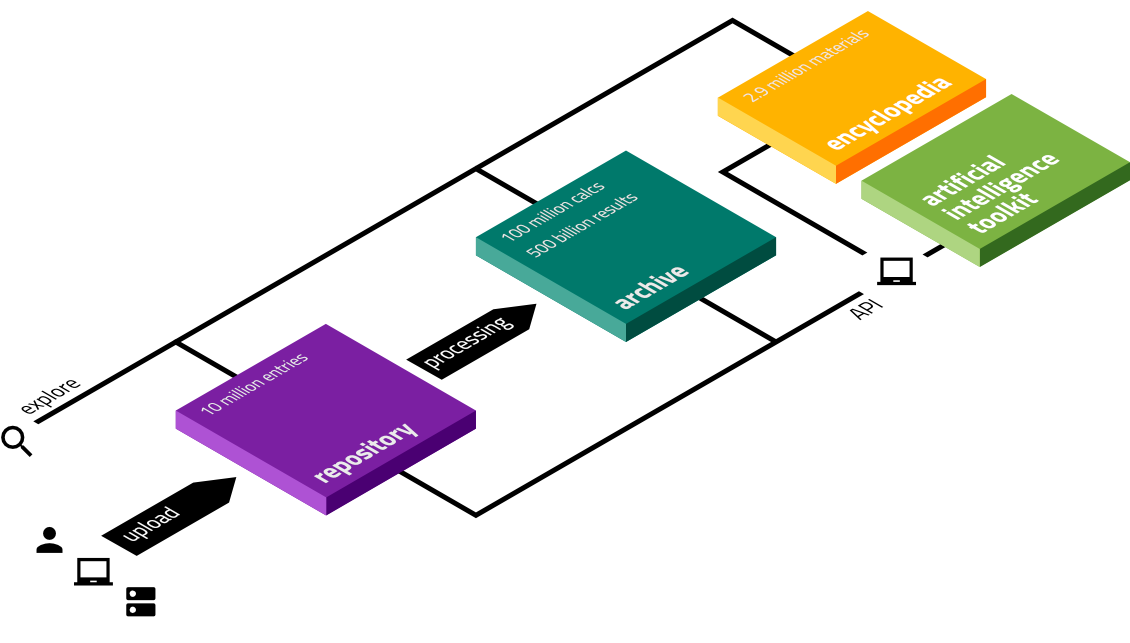
Platform architecture — distributed workers, polyglot persistence, dual deployment targets. Same codebase runs at MPCDF Garching, at partner institutes worldwide, and (forked) as FoamPrisma.
NOMAD's surface area is enormous — schemas, plugins, parsers, deployment patterns, the metainfo system, dozens of integration paths — and onboarding used to mean a week of reading scattered documentation and tracing example plugins by hand.
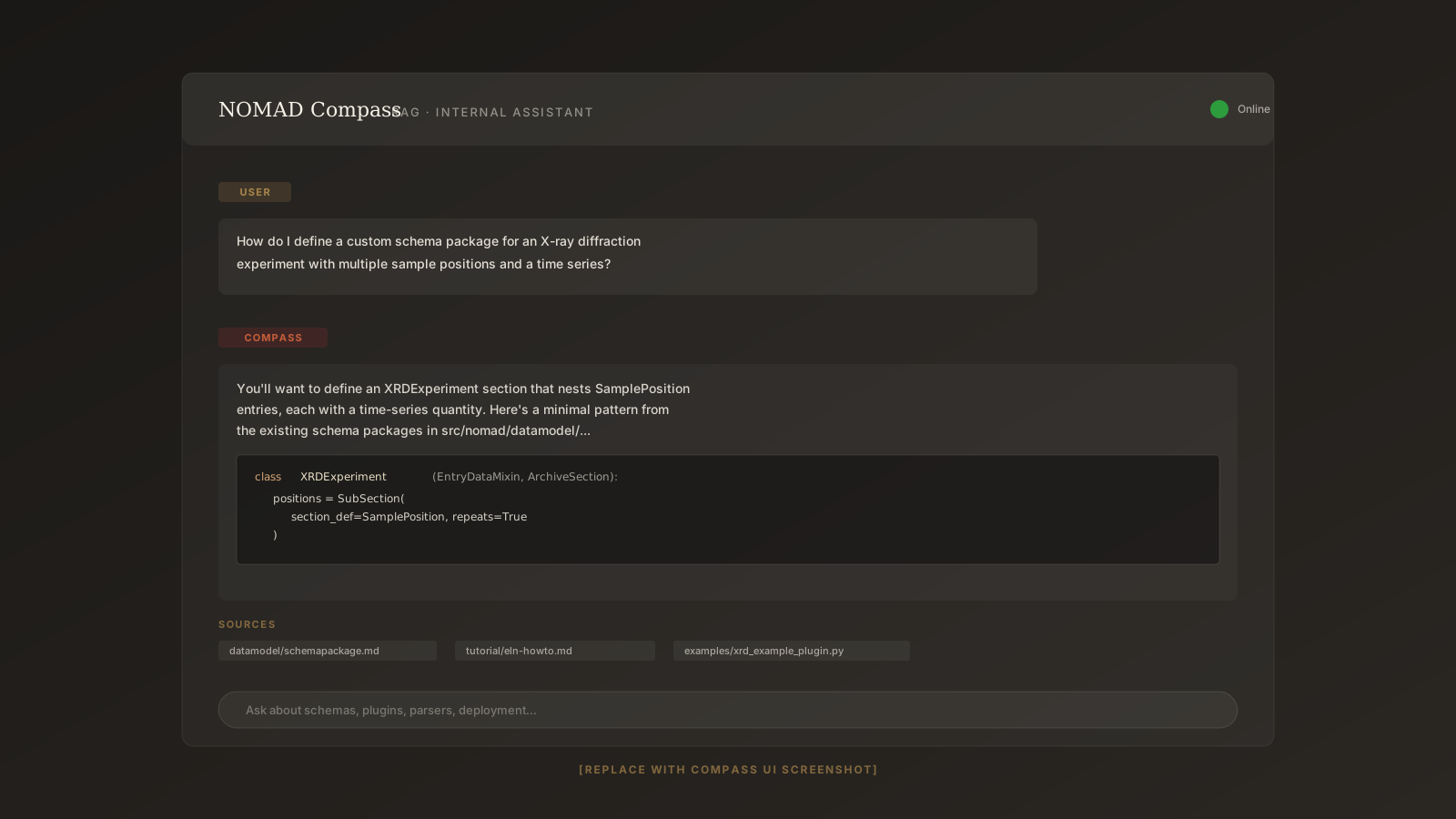
I architected NOMAD Compass: an internal RAG assistant that ingests the full NOMAD documentation tree, schema definitions, and selected example code, and answers natural-language questions with explicit citations back to source. The retrieval pipeline embeds every documentation chunk and code example into a vector store, and a Python service handles query, context selection, and response generation with source attribution. What used to take a week now takes a conversation.
A typical Compass conversation — natural-language query, response with code example, explicit source citations to docs and example plugins.
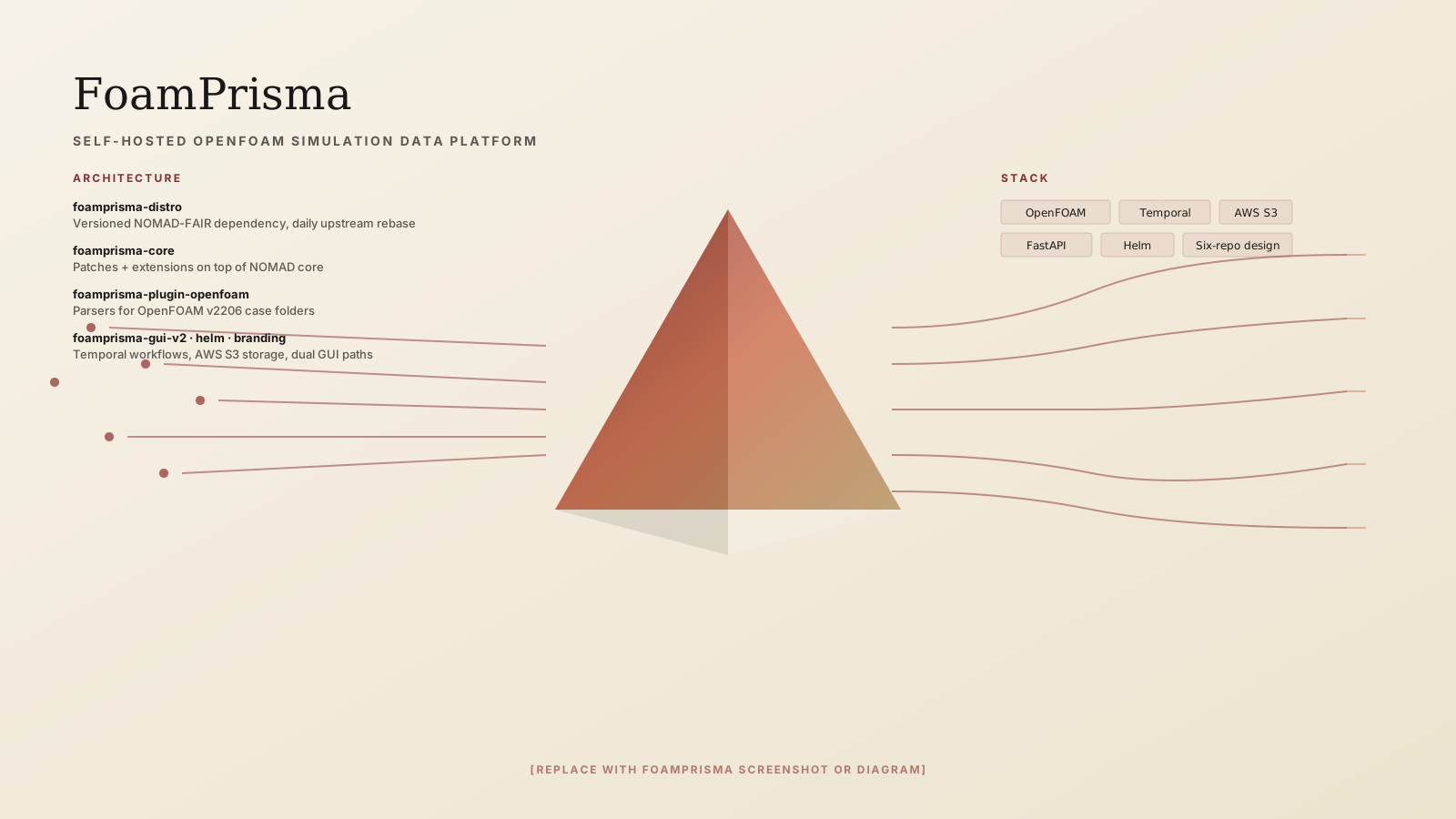
FoamPrisma is a self-hosted AWS deployment that rebrands and extends NOMAD for OpenFOAM CFD simulation data — the same architectural ideas applied to a different scientific domain. It treats nomad-FAIR as a versioned dependency rather than a fork, following the nomad-distro-template pattern: a six-repository structure where upstream changes flow in via automated daily rebases, while CFD-specific extensions (an OpenFOAM v2206 parser, Temporal workflows for long-running simulation ingest, S3 storage adapters) live in their own packages.
The constraint that drove the architecture: the internal Python package retains the name nomad to facilitate clean upstream merges, while every external surface — GUI, API, branding — adopts the FoamPrisma identity. It runs in two GUI modes (/gui-v1, /gui-v2) to support both legacy and new workflows during transition.
Six-repository architecture — distribution shell, core extensions, OpenFOAM plugin, Helm chart, custom GUI, and branding kept separable for clean upstream integration.
Before software became the work, it was the tool. Six years of computational research in petroleum
engineering, earth sciences, and reactive transport — much of it now embedded in code I still maintain.
P3D-BRNS v1.0.0
open source · research
2018 — 2024
C++·OpenFOAM·software paper published 2024
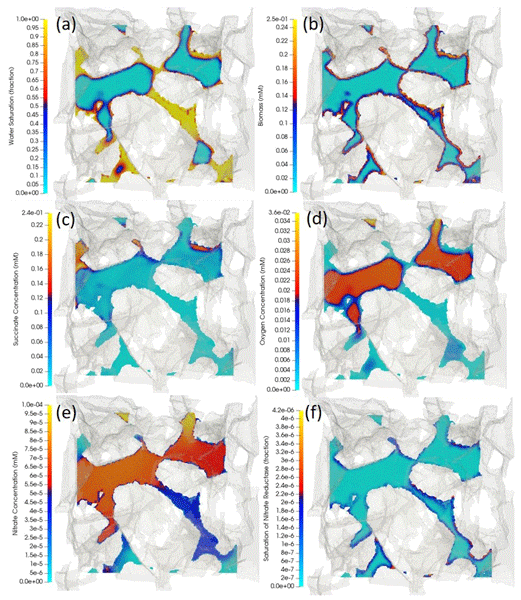
P3D-BRNS is a three-dimensional, multiphase, multicomponent, pore-scale reactive transport modelling package for simulating biogeochemical processes in subsurface environments. It takes micro-CT images of porous structures — soil, rock, biofilm — discretizes the pore space, and solves the coupled flow, transport, and reaction equations directly on the geometry.
I built it during my PhD work as a research toolbox; the v1.0.0 release in 2024 was the formalization, published as a software paper. The codebase is C++ on top of OpenFOAM, with the reactive transport solver coupled to OpenFOAM's finite-volume CFD machinery. Open source and used by other research groups working on subsurface biogeochemistry.
Simulated pH front advancing through a micro-CT grain pack. The combination of micro-CT geometry with reactive transport at pore scale is what makes the package distinctive — most reactive transport codes operate at continuum scale.
P3D-BRNS v1.0.0: A three-dimensional, multiphase, multicomponent, pore-scale reactive transport modelling package for simulating biogeochemical processes in subsurface environments
2023
NOMAD: A distributed web-based platform for managing materials science research data
2021
Pore-scale modeling of microbial activity: What we have and what we need
Vadose Zone Journal
2019
A comprehensive review of pore scale modeling methodologies for multiphase flow in porous media
Advances in Geo-Energy Research
2018
A support vector machine analysis to predict density of mixtures of methanol and six ionic liquids
Monatshefte für Chemie
2014
A Critical Review of Improved Oil Recovery by Electromagnetic Heating
03 //
Experience & education
17 years · 4 countries
From petroleum engineering in Iran to materials-science platforms in Berlin, by way of a research
fellowship in Aberdeen. Not the most direct path; in retrospect, the right one.
Employment
2022 — nowSenior Full-Stack DeveloperFAIRmat · Humboldt-Universität zu Berlin
2020 — 2022Backend DeveloperFAIRmat · Humboldt-Universität zu Berlin
2018 — 2022Scientific ResearcherHelmholtz Centre for Environmental Research · Leipzig
2017 — 2018Graduate Teaching AssistantUniversity of Aberdeen · Scotland
Education
2021 — nowPhD · Geoscience & MicrobiologyLeibniz Universität Hannover